
Balanced Funds
What is a Balanced Fund?
A balanced fund is a type of mutual fund that invests in both equity (stocks) and debt securities (such as bonds). By combining these two asset classes, balanced funds aim to provide long-term capital appreciation while reducing investment risk compared with pure equity funds. The proportion invested in equity and debt varies depending on the fund’s objective, making balanced funds suitable for investors seeking a balance between growth and stability.
Types of balanced funds
Balanced funds can be classified in two categories. 1) Equity oriented, where major investment is in equity. 2) Debt oriented, where major investment is in bonds and other debt instruments.
Equity-Oriented Balanced Funds: These funds invest at least 65% of their assets in equity and equity-related securities, with the remaining portion allocated to debt instruments. They have higher return potential but also experience greater market fluctuations.
Debt-Oriented Balanced Funds: These funds invest the majority of their assets in debt instruments such as government securities and corporate bonds, while a smaller portion is allocated to equities. They generally offer lower risk and more stable returns than equity-oriented balanced funds.
Balanced Funds: Meaning, Types, Benefits, Risks & How They Work
Components of Balanced Funds
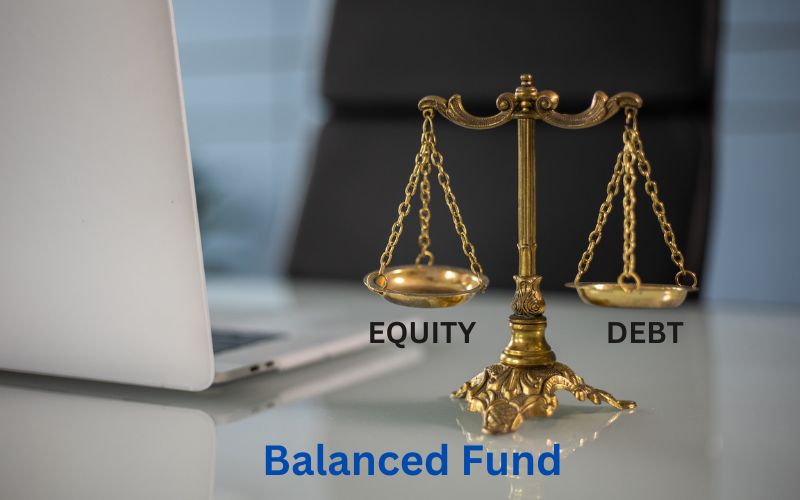
A balanced fund divides your investment between equity (stocks) and debt instruments (such as government securities and corporate bonds). This combination is designed to balance growth potential with risk management.
- Equity Component: The equity portion aims to generate long-term capital appreciation. Since stock prices fluctuate with market conditions, this part of the portfolio offers higher return potential but also carries higher risk.
- Debt Component: The debt portion invests in relatively stable fixed-income securities. It helps reduce overall portfolio volatility, provides a steady income stream, and cushions the impact of sharp market declines.
By combining these two asset classes in a single portfolio, balanced funds strive to deliver more stable returns than pure equity funds while offering better growth potential than investing only in debt instruments.
Who should invest in balanced funds?
Balanced funds are ideal for investors who want to participate in the stock market without taking the full risk associated with investing entirely in equities.
These funds may be suitable if you:
- Are a first-time mutual fund investor.
- Have a medium- to long-term investment horizon (generally 3–5 years or more).
- Want a balance between capital appreciation and stability.
- Prefer moderate risk instead of the high volatility of pure equity funds.
- Are investing through a Systematic Investment Plan (SIP) or making a lump-sum investment for long-term goals.
Who Should Avoid Balanced Funds?
Balanced funds may not be the right choice for everyone.
You may want to consider other investment options if you:
- Need your money within the next one or two years.
- Are looking for guaranteed or fixed returns.
- Cannot tolerate any fluctuations in the value of your investment.
- Prefer investing only in equity funds for maximum long-term growth or only in debt funds for greater stability.
efore investing, always evaluate your financial goals, risk tolerance, and investment horizon to determine whether a balanced fund aligns with your needs.
Advantages of balanced funds
Balanced funds offer several advantages by combining the growth potential of equities with the relative stability of debt instruments. Some of the key benefits are discussed below.
- Reduced Investment Risk: One of the biggest advantages of balanced funds is their ability to reduce overall investment risk. Since a portion of the portfolio is invested in debt instruments, losses during stock market downturns are often lower than those of pure equity funds. This balanced allocation helps investors experience a smoother investment journey.
- Diversification Across Asset Classes: Balanced funds automatically diversify your investment by allocating money to both equity and debt securities. This diversification reduces the impact of poor performance in any single asset class and lowers the overall portfolio risk. Investors also benefit from professional portfolio management without having to invest separately in multiple funds.
- Potential to Beat Inflation: Inflation gradually reduces the purchasing power of money over time. The equity component of balanced funds provides an opportunity for long-term capital appreciation, helping investors generate returns that have the potential to outpace inflation. At the same time, the debt portion offers greater stability during periods of market uncertainty.
- Automatic Portfolio Rebalancing: Balanced funds are actively managed by professional fund managers who periodically rebalance the portfolio. When stock markets become overvalued, the manager may reduce the equity allocation and increase investments in debt instruments to manage risk. Conversely, during market corrections or attractive valuations, the fund manager may increase equity exposure to capture future growth opportunities. This automatic rebalancing helps maintain the fund’s investment objective without requiring any action from investors.
- Professional Fund Management: Balanced funds are managed by experienced investment professionals who continuously monitor market conditions, select securities, and maintain the desired asset allocation. This makes balanced funds a suitable option for investors who may not have the time or expertise to manage their own investment portfolio.
- Suitable for Moderate-Risk Investors: Balanced funds are designed for investors seeking a balance between growth and stability. They are particularly suitable for individuals with a moderate risk appetite who want better return potential than traditional fixed-income investments while avoiding the higher volatility associated with pure equity funds.
Tax Treatment for Balanced Funds
The tax treatment of a balanced fund depends on its equity allocation. Funds that invest more than 65% of their portfolio in equity and equity-related securities are generally treated as equity-oriented mutual funds for taxation purposes. On the other hand, funds with a lower equity allocation are taxed according to the rules applicable to debt-oriented mutual funds.
Since the tax rules for equity-oriented and debt-oriented funds differ, investors should always check the fund’s asset allocation before investing. Factors such as the holding period, capital gains, and applicable tax laws determine the final tax liability.
As tax regulations may change over time, investors should refer to the latest government guidelines or consult a qualified tax professional before making investment decisions.
You may like to read: Types of mutual funds